Language
 English
 中文简体
 русский
 Español
 عربى
Material Selection for Butt Weld Fittings Choosing the right material is the first step in selecting...
Home / News / Company News / Automatic Longitudinal Welding of Large Diameter Elbows – Strict In-process Quality Supervision
Automatic Longitudinal Welding of Large Diameter Elbows – Strict In-process Quality Supervision

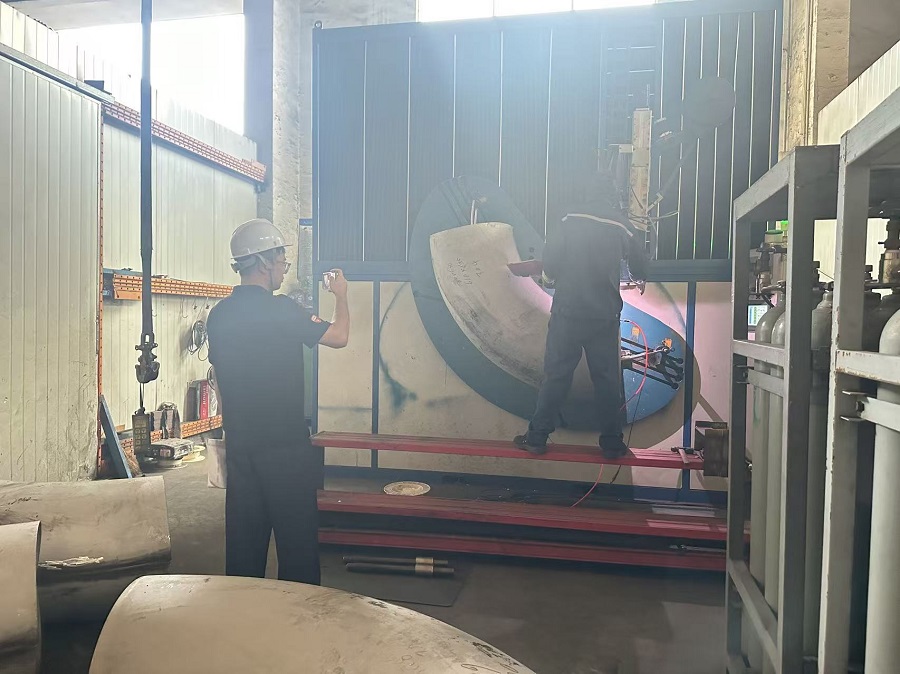
This shot was taken during the automatic submerged arc welding process of our large-bore elbow. Our certified welder operates the welding machine while our quality inspector monitors the whole welding procedure on-site for full traceability.
Large diameter elbows beyond seamless production limits rely on longitudinal welding. We adopt automatic submerged arc welding for this step, which delivers stable weld bead formation, consistent penetration and low defect rate compared with manual welding. Before welding starts, we verify material heat number, fit-up gap and alignment strictly following WPS & PQR documents.
Our quality team keeps close supervision throughout welding. Every welding parameter including current, voltage, travel speed and heat input is recorded. Real-time on-site inspection helps catch any abnormality immediately, avoiding hidden weld defects that may affect pipeline safety in long-term service. After welding is finished, the weld seam will go through visual inspection, UT or RT non-destructive testing as per project requirements.
All our longitudinally welded pipe fittings are manufactured to ASME B16.9. We can fabricate carbon steel, alloy steel and stainless steel large elbows, tees and reducers for oil & gas transmission, power plants and chemical pipeline systems. Rigorous in-process control is our foundation to guarantee reliable fitting quality for critical energy projects.
If you have inquiries about custom large diameter welded pipe fittings, welcome to share your drawings and technical specifications with us.
Latest News
News And Blogs
Stay Informed About Our Recent Events