Language
 English
 中文简体
中文简体 русский
 Español
 عربى
عربى
Material Selection for Butt Weld Fittings Choosing the right material is the first step in selecting...
Home / News / Industry News / What Are the Different Types of Stainless Steel Flanges and How Do You Choose the Right One?
What Are the Different Types of Stainless Steel Flanges and How Do You Choose the Right One?

Content
Why Understanding Flange Types Matters
Stainless steel flanges are used to connect pipes, valves, pumps, and other equipment in piping systems across industries like oil and gas, chemical processing, water treatment, and food production. Choosing the wrong flange type, grade, or standard can lead to leaks, premature corrosion, or costly compatibility issues during installation. Because flanges are categorized by shape, connection method, material grade, and dimensional standard, understanding how these categories work together is essential for specifying the right component for any piping project.
This guide breaks down the main flange types by shape and function, the most common stainless steel grades used in manufacturing them, and the dimensional standards that govern their sizing, so buyers and engineers can make confident, accurate selections.
Flange Types by Shape and Connection Method
Flanges are primarily classified by how they attach to the pipe and the shape of their sealing face. Each type suits different pressure ratings, maintenance needs, and installation conditions.
Weld Neck Flanges
Weld neck flanges feature a tapered hub that is butt-welded directly to the pipe, creating a smooth transition that reduces stress concentration. They are widely used in high-pressure and high-temperature applications because the design distributes stress more evenly than other flange types, minimizing the risk of failure at the joint.
Slip-On Flanges
Slip-on flanges slide over the pipe end and are welded both inside and outside for added strength. They are easier and faster to install than weld neck flanges, and their lower cost makes them popular for low-pressure applications, though they are not recommended for high-pressure or cyclic-load environments due to lower fatigue resistance.
Blind Flanges
Blind flanges have no center bore and are used to seal the end of a piping system, valve opening, or pressure vessel. They allow for future system expansion or provide access points for inspection and maintenance without requiring a full pipe section replacement.
Socket Weld Flanges
Socket weld flanges have a recessed area where the pipe is inserted before welding around the outer edge. This design provides a smooth interior bore that improves fluid flow, making them a good fit for smaller diameter, high-pressure piping systems, though they are generally limited to pipe sizes under 4 inches.
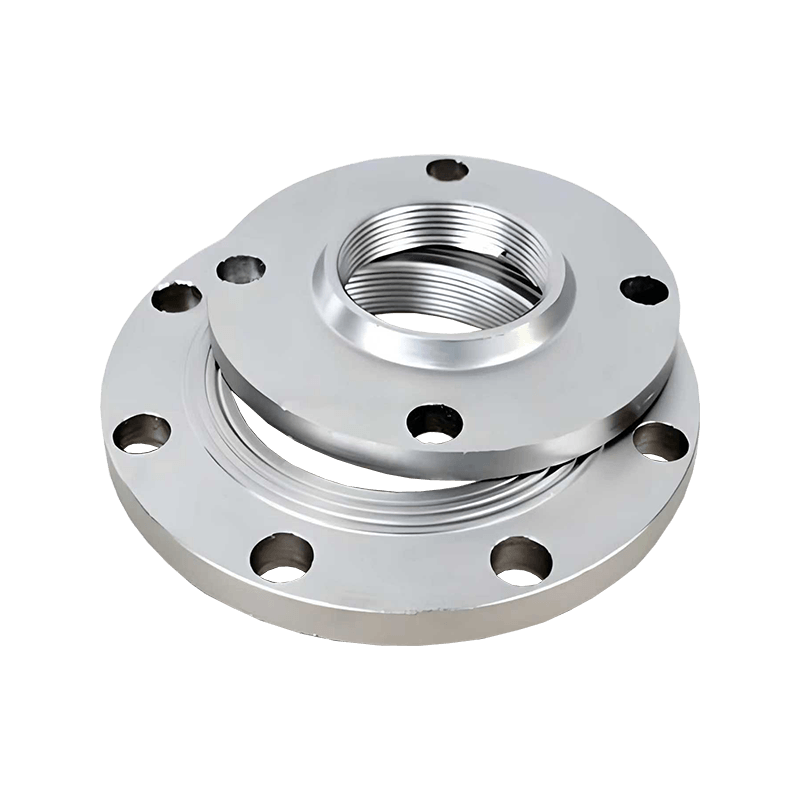
Threaded Flanges
Threaded flanges connect to pipe via matching threads rather than welding, which makes them useful in situations where welding poses a safety risk, such as explosive or flammable environments. They are generally limited to lower pressure applications and smaller pipe sizes.
Lap Joint Flanges
Lap joint flanges are used with a stub end and allow the flange to rotate freely around the pipe, simplifying bolt-hole alignment during installation. They are commonly used in systems that require frequent dismantling for cleaning or inspection, such as those found in food and beverage processing.
Common Stainless Steel Grades Used in Flanges
The stainless steel grade used to manufacture a flange determines its corrosion resistance, strength, and suitability for specific media and environments. The table below summarizes the most frequently specified grades.
| Grade | Key Characteristics | Typical Applications |
| 304 / 304L | Good general corrosion resistance, cost-effective | Food processing, general piping |
| 316 / 316L | Molybdenum added for better chloride resistance | Marine, chemical, pharmaceutical systems |
| 321 | Titanium stabilized, resists sensitization at high heat | High-temperature piping, aerospace |
| Duplex 2205 | High strength, excellent stress corrosion resistance | Offshore, oil and gas |
| 17-4 PH | Precipitation hardened, very high strength | Aerospace, high-stress components |
Dimensional Standards Governing Flange Sizing
Flange dimensions, bolt patterns, and pressure ratings are governed by regional and international standards, and matching the correct standard is critical for ensuring compatible connections between mating components.
- ASME/ANSI B16.5: the most widely used standard in North America, covering flanges from 1/2 inch to 24 inches in various pressure classes
- EN 1092-1: the primary European standard, defining flange dimensions and pressure ratings (PN ratings) for use across the EU
- DIN 2576/2633: German standards still referenced in many European and export markets, particularly for older equipment
- JIS B2220: the Japanese standard, common in equipment manufactured for or imported from Japan
- GB/T 9119: the Chinese national standard, widely used in domestic Chinese manufacturing and export piping systems
Mixing flanges from different standards, even if they appear similar, can result in mismatched bolt hole patterns or incompatible sealing faces, so confirming the applicable standard before ordering is a critical step in the specification process.
Understanding Pressure Classes and Ratings
Pressure class, often labeled as Class 150, 300, 600, and so on under ASME standards, or as PN ratings like PN10, PN16, or PN40 under European standards, indicates the maximum pressure a flange can safely handle at a given temperature. As temperature increases, the allowable pressure rating typically decreases, so engineers must reference pressure-temperature rating charts specific to the flange's material grade rather than relying on the class number alone.
Selecting a flange with a pressure class that matches or exceeds the system's operating conditions, including anticipated pressure spikes or thermal cycling, helps prevent joint failure and ensures the flange performs reliably over its intended service life.
Practical Tips for Selecting the Right Flange
When specifying stainless steel flanges for a project, start by confirming the piping system's operating pressure, temperature, and the chemical properties of the media being transported, since these factors determine both the appropriate grade and pressure class. Next, identify the correct dimensional standard based on the region of installation and the standards used by mating equipment, to avoid costly compatibility issues during assembly.
Finally, consider maintenance requirements when choosing the connection type. Systems that require frequent disassembly for cleaning or inspection often benefit from lap joint or slip-on designs, while permanent, high-pressure installations are better served by weld neck flanges. Requesting mill test certificates and verifying grade markings on delivery also helps confirm that the received flanges match the specified material and standard before installation begins.
Latest News
News And Blogs
Stay Informed About Our Recent Events