Language
 English
 中文简体
中文简体 русский
 Español
 عربى
عربى
Material Selection for Butt Weld Fittings Choosing the right material is the first step in selecting...
Top 8 Things You Did Not Know About Carbon Steel Flanges

Content
- 1 Carbon Steel Flanges Can Outperform Stainless Steel in Specific Conditions
- 2 The Grain Flow Direction Matters More Than You Think
- 3 Heat Treatment Transforms Carbon Steel Flange Properties
- 4 Pressure-Temperature Ratings Are More Complex Than Standard Tables Suggest
- 5 Surface Finish Affects Sealing Performance as Much as Gasket Selection
- 6 Bolt Hole Tolerances Create Hidden Stress Concentrations
- 7 Carbon Content Variations Within Grade Specifications Have Major Implications
- 8 Low-Temperature Service Requires Special Considerations Beyond Material Selection
- 9 Flange Face Alignment Tolerance Affects Joint Integrity More Than Bolt Torque
Carbon steel flanges are ubiquitous components in piping systems across countless industries, from oil and gas to chemical processing and power generation. While most engineers and technicians work with these critical connectors regularly, there are fascinating aspects of carbon steel flange design, manufacturing, and performance that remain surprisingly unknown even to experienced professionals. Understanding these lesser-known facts can significantly impact system design decisions, maintenance strategies, and overall operational safety. This article reveals eight important insights about carbon steel flanges that will deepen your understanding of these essential piping components and potentially change how you approach flange selection and application.
Carbon Steel Flanges Can Outperform Stainless Steel in Specific Conditions
Contrary to common perception that stainless steel is always superior, carbon steel flanges actually outperform stainless steel alternatives in certain critical applications. In high-temperature hydrogen service, carbon steel demonstrates better resistance to hydrogen embrittlement than many austenitic stainless steels. The body-centered cubic crystal structure of ferritic carbon steel at elevated temperatures provides pathways for hydrogen atoms to diffuse through the material without causing the catastrophic cracking that can occur in face-centered cubic austenitic structures under sustained hydrogen exposure.
Additionally, carbon steel flanges exhibit superior resistance to chloride-induced stress corrosion cracking compared to austenitic stainless steels like 304 or 316. In environments where chlorides are present but general corrosion is not severe—such as certain coastal atmospheric exposures or intermittent wet-dry cycling—carbon steel with appropriate coatings can provide more reliable long-term performance than unprotected stainless steel, which may develop unexpected stress corrosion cracks at welds or high-stress regions. This advantage becomes particularly significant in applications where tensile stresses from bolt preload or thermal cycling create conditions conducive to stress corrosion cracking.
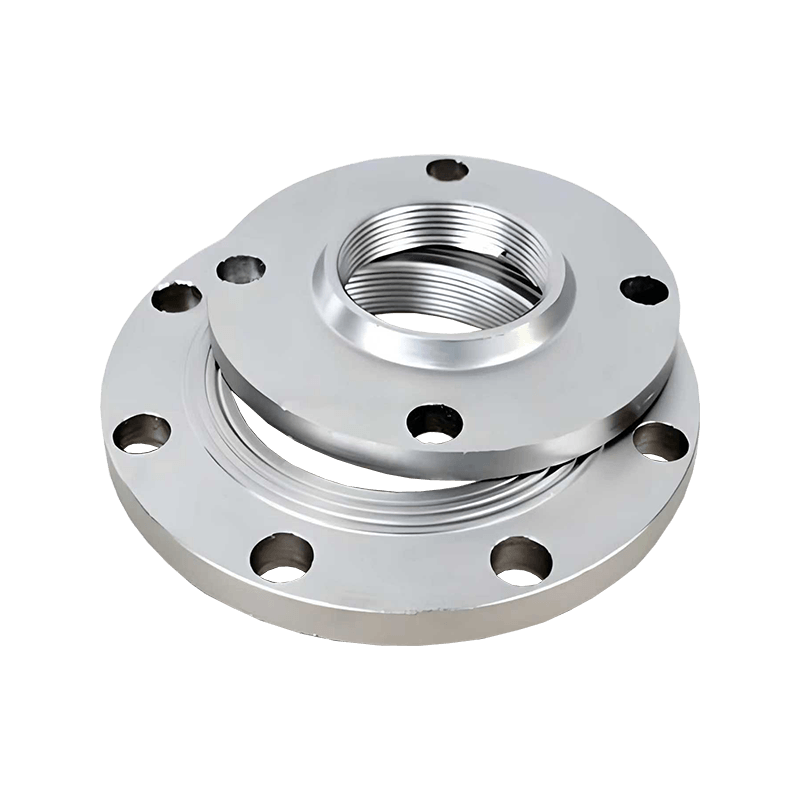
The Grain Flow Direction Matters More Than You Think
The manufacturing process used to produce carbon steel flanges creates distinct grain flow patterns that dramatically affect mechanical properties and performance, yet this critical factor is rarely discussed outside metallurgical circles. Forged flanges, produced by hot working steel billets under high pressure, develop grain flow that follows the flange contours, wrapping around the bore and extending outward toward the bolt holes. This continuous grain flow, much like the growth rings in wood, provides superior strength and toughness in critical stress directions compared to machined flanges cut from plate stock, where grain flow is interrupted and runs perpendicular to stress directions.
The practical implications are significant. Forged flanges with optimized grain flow can withstand 20-30% higher stress levels than equivalent plate-cut flanges before crack initiation occurs. This advantage becomes critical in high-pressure services, cyclic loading applications, or low-temperature operations where material toughness is paramount. ASME B16.5 standards mandate forging for certain pressure classes and sizes specifically because of these grain flow benefits, though many engineers don't fully understand the metallurgical reasoning behind these requirements. When evaluating flange failures, examining grain orientation relative to crack propagation paths often reveals that improper grain flow contributed to premature failure.
Heat Treatment Transforms Carbon Steel Flange Properties
While many assume all carbon steel flanges within a given grade are essentially identical, post-forging heat treatment creates dramatic variations in mechanical properties and performance characteristics. Normalizing—heating steel to above its upper critical temperature followed by air cooling—refines grain structure and creates uniform, fine-grained microstructure that optimizes the balance between strength and toughness. This treatment is mandatory for many applications but optional for others, creating significant property differences between normalized and non-normalized flanges of the same nominal material specification.
Stress relieving, performed at lower temperatures than normalizing, reduces residual stresses from forging and machining without significantly altering microstructure. For large-diameter flanges or those with complex geometries, stress relief prevents distortion during service and reduces susceptibility to stress-corrosion cracking. The temperature and duration of stress relief treatments must be carefully controlled—insufficient treatment leaves harmful residual stresses, while excessive treatment can reduce strength below specification minimums. Surprisingly, ASME standards don't always mandate stress relief even for applications where it would provide substantial benefits, leaving this critical decision to engineer specification or manufacturer discretion.
Quenching and Tempering for Extreme Conditions
For the most demanding applications—high pressures combined with low temperatures, or services requiring exceptional strength—carbon steel flanges can receive quenching and tempering treatments that double or triple yield strength compared to as-forged material. This process involves heating to austenitizing temperature, rapidly cooling (quenching) to form hard martensite, then reheating (tempering) to achieve the desired strength-toughness balance. Few engineers realize that carbon steel can achieve yield strengths exceeding 700 MPa through proper heat treatment, rivaling many alloy steels at a fraction of the cost.
Pressure-Temperature Ratings Are More Complex Than Standard Tables Suggest
The pressure-temperature ratings published in ASME B16.5 and similar standards present simplified values that mask considerable complexity in how carbon steel flanges actually perform across varying conditions. These ratings are based on allowable stress values that decrease with increasing temperature as material strength degrades with heat exposure. However, what's less understood is that these ratings assume specific material grades, heat treatments, and service conditions—deviations from these assumptions can dramatically affect safe operating limits.
For instance, standard pressure ratings assume non-shock service with gradual pressure changes. Applications involving pressure surges, water hammer, or rapid thermal transients require derating to account for dynamic loading and thermal stress. Similarly, the published ratings don't explicitly account for external loads from piping deflection, seismic activity, or wind forces, which can add significant stresses to the flange. Cyclic service, where pressure and temperature fluctuate repeatedly, introduces fatigue considerations not captured in static pressure ratings. Engineers must apply appropriate reduction factors for these conditions, yet this requirement is often overlooked, leading to flanges operating beyond their true safe limits.
| Service Condition | Recommended Derating Factor | Reason |
| Cyclic pressure (>7000 cycles/year) | 0.8-0.9 | Fatigue considerations |
| Shock or water hammer | 0.6-0.8 | Dynamic stress amplification |
| Rapid thermal cycling | 0.7-0.85 | Thermal stress and fatigue |
| Corrosive environment | 0.75-0.9 | Reduced wall thickness over time |
Surface Finish Affects Sealing Performance as Much as Gasket Selection
While engineers carefully select gasket materials and types, the flange face finish often receives inadequate attention despite its critical role in achieving reliable sealing. ASME B16.5 specifies surface finish ranges for different flange facings, but what's not widely appreciated is how dramatically finish quality affects gasket performance and leak prevention. The standard raised face finish of 125-250 microinches Ra (arithmetic average roughness) represents a compromise—smoother finishes may not provide adequate bite for soft gaskets, while rougher finishes can damage gaskets or create leak paths.
The surface finish pattern matters as much as roughness magnitude. Serrated or phonographic finishes, created by specific lathe tooling, produce concentric grooves that help seat soft gaskets and provide leak-tight seals even with minor flange warpage. Spiral-serrated finishes, though less common, can accommodate greater surface irregularities while maintaining sealing effectiveness. Conversely, random or multidirectional scratches create potential leak paths that no amount of bolt torque can completely seal. Many flange leaks attributed to gasket failure or insufficient bolt load actually stem from improper surface finish resulting from poor machining practices, field damage during handling, or corrosion pitting that destroys the original finish.
Re-Facing Considerations
Carbon steel flanges can be re-faced multiple times to restore sealing surfaces damaged by corrosion, erosion, or mechanical damage. However, each re-facing operation removes material, gradually reducing the raised face height and potentially affecting hub thickness at the face-to-hub transition. After several re-facing operations, the flange may no longer meet original dimensional specifications, even though it appears serviceable. Smart maintenance programs track the number and depth of re-facing operations to retire flanges before dimensional degradation compromises pressure-containing integrity.
Bolt Hole Tolerances Create Hidden Stress Concentrations
ASME B16.5 specifies relatively generous tolerances for bolt hole diameters—typically 1.5mm (1/16 inch) larger than bolt diameter to facilitate assembly. While this clearance simplifies installation, it creates an often-overlooked problem: uneven load distribution among bolts when holes are at maximum tolerance and bolts must cant to pass through misaligned holes. This misalignment introduces bending stresses in bolts and creates stress concentrations at the edge of bolt holes where the bolt shank bears against the hole wall.
In critical services, particularly those involving cyclic loading or vibration, these stress concentrations can initiate fatigue cracks that propagate from bolt holes into the flange body. The problem intensifies when flanges are field-drilled or when bolt hole positions deviate from the ideal equal spacing around the flange bolt circle. Research has shown that bolt hole stress concentrations can reduce flange fatigue life by 30-50% compared to theoretical calculations assuming perfect hole alignment and uniform loading. This hidden factor explains many unexpected flange failures in services where stress calculations suggest adequate safety margins.
Carbon Content Variations Within Grade Specifications Have Major Implications
Carbon steel flange materials like ASTM A105 specify carbon content ranges rather than exact values—typically 0.35% maximum carbon for A105. What many don't realize is that material at the low end of this range (0.20% carbon) behaves dramatically differently than material at the high end (0.35% carbon), even though both meet the specification. Higher carbon content increases strength and hardness but reduces weldability and ductility. Lower carbon content improves weldability and toughness but may reduce strength, particularly at elevated temperatures.
This variation matters tremendously for specific applications. For flanges that will be welded to piping, lower carbon content minimizes heat-affected zone hardening and reduces preheat requirements, simplifying fabrication and reducing welding costs. For high-temperature service where creep resistance is critical, higher carbon content provides better strength retention. Unfortunately, unless specifically requested and verified through mill test reports, purchasers have no control over where within the allowable range their flanges fall. Sophisticated buyers specify narrow carbon ranges tailored to their specific application requirements, ensuring more consistent and predictable performance.
Low-Temperature Service Requires Special Considerations Beyond Material Selection
Carbon steel becomes increasingly brittle as temperature decreases, transitioning from ductile to brittle failure modes at the material's ductile-to-brittle transition temperature (DBTT). While most engineers know that special low-temperature carbon steels or impact-tested materials are required for cryogenic or cold service, less understood are the subtle factors that affect actual transition temperature in service. Residual stresses from manufacturing, stress concentrations at geometric discontinuities, and prior strain history all shift the effective DBTT to higher temperatures than virgin material testing would suggest.
ASME B31.3 process piping code provides impact testing exemption curves based on minimum design temperature and material thickness, allowing use of standard carbon steel without impact testing above certain temperatures. However, these exemptions assume specific conditions—no shock loading, no rapid depressurization, and no prior service that might have degraded toughness. Applications involving any of these factors require impact-tested materials even when exemption curves would otherwise permit standard material. Furthermore, the standard Charpy V-notch impact test used to qualify materials tests small specimens under idealized conditions—actual flange components with stress concentrations at hub-to-face transitions or bolt holes may exhibit lower toughness than test specimens suggest.
Thermal Shock Considerations
- Rapid cooling from ambient to service temperature can induce thermal stresses exceeding material yield strength
- Cold liquid pooling in flange recesses creates localized cold spots with severe temperature gradients
- Pre-cooling procedures that gradually reduce temperature prevent thermal shock damage
- Flange insulation and heat tracing maintain temperature above DBTT during shutdowns
Flange Face Alignment Tolerance Affects Joint Integrity More Than Bolt Torque
Installation guidelines emphasize achieving proper bolt torque to create adequate gasket compression and prevent leaks. However, research and field experience demonstrate that flange face alignment—the parallelism and gap between mating flange faces—affects joint performance as much or more than bolt loading. When flange faces are not parallel, bolt tightening creates non-uniform gasket compression with over-compressed regions near the point of closest approach and under-compressed regions at the widest gap. This non-uniformity creates leak paths even when average bolt stress appears adequate.
ASME PCC-1 guidelines recommend maintaining flange face parallelism within 0.5mm per meter of flange diameter, yet this requirement is frequently violated during field installation. Piping misalignment, improper support, or foundation settlement creates flange rotation that exceeds this limit. The consequences include accelerated gasket failure, preferential leakage at specific circumferential locations, and uneven bolt loading that can lead to bolt fatigue failure. Advanced gasket designs with greater conformability can accommodate some misalignment, but severe face rotation exceeds any gasket's ability to compensate. Paradoxically, increasing bolt torque to stop leaks from misaligned flanges often worsens the problem by over-crushing gaskets in compressed regions while still under-loading the gapped areas.
Alignment Verification Methods
Professional installers use feeler gauges at multiple circumferential positions to measure the gap between flange faces before bolt tightening, ensuring gaps remain within acceptable limits. Laser alignment tools provide more sophisticated measurement for critical or large-diameter flanges where even minor misalignment creates significant problems. For permanently installed flanges, periodic alignment verification detects foundation settlement or pipe support degradation before leaks develop. Correcting alignment issues before joint assembly prevents chronic leaking problems that resist resolution through gasket replacement or increased bolt torque alone.
These eight insights into carbon steel flange behavior, manufacturing, and application reveal the complexity beneath these seemingly simple piping components. Understanding grain flow orientation, heat treatment effects, pressure rating limitations, surface finish requirements, bolt hole stress concentrations, carbon content implications, low-temperature brittleness factors, and alignment criticality enables engineers to make better design decisions, specify appropriate materials and manufacturing requirements, and implement effective installation and maintenance practices. While carbon steel flanges may appear commodity items, optimal performance requires attention to numerous subtle factors that profoundly affect reliability, safety, and service life. Applying this knowledge helps prevent failures, reduce maintenance costs, and ensure piping systems operate safely throughout their intended service life.
Latest News
News And Blogs
Stay Informed About Our Recent Events