Language
 English
 中文简体
中文简体 русский
 Español
 عربى
عربى
Material Selection for Butt Weld Fittings Choosing the right material is the first step in selecting...
Home / News / Industry News / Understanding Butt Weld Pipe Caps and Their Applications in Piping Systems
Understanding Butt Weld Pipe Caps and Their Applications in Piping Systems

Content
- 1 What Is a Butt Weld Pipe Cap and How It Functions in a Piping System
- 2 Head Geometry Types: Ellipsoidal, Hemispherical, and Flat Cap Profiles
- 3 Material Grades and Standards for Butt Weld Pipe Caps
- 4 Dimensional Standards and Size Range for Butt Weld Caps
- 5 Wall Thickness Schedule Selection and Pressure Rating Implications
- 6 Key Industrial Applications of Butt Weld Pipe Caps
- 7 Welding, Inspection, and Quality Requirements for Butt Weld Cap Joints
- 8 Procurement Checklist for Butt Weld Pipe Caps in Critical Service
What Is a Butt Weld Pipe Cap and How It Functions in a Piping System
A butt weld pipe cap is a pressure-containing pipe fitting designed to permanently close the open end of a pipe by welding directly to the pipe wall at the beveled joint interface. Unlike threaded caps or socket weld caps — which rely on mechanical connection or fillet weld to a socket interior — a butt weld cap is prepared with a matching bevel angle at its open end, aligned with the pipe end bevel, and joined by a full-penetration groove weld that fuses the fitting wall to the pipe wall across the entire cross-section of the joint. This welded connection creates a sealed, monolithic closure that becomes an integral part of the piping system, capable of sustaining the same internal pressure, temperature, and mechanical loads as the connected pipe itself.
The functional role of a butt weld pipe cap in a piping system is to terminate a pipe run — whether permanently, as in the case of a dead-end branch or a hydrostatically tested line end, or temporarily during construction when future connections are planned. The hemispherical or ellipsoidal dome geometry of the cap's closed end distributes internal pressure stress uniformly across the curved surface, which is significantly more efficient than a flat closure plate of equivalent thickness. This geometric efficiency means that a correctly designed butt weld cap can sustain higher internal pressures with less material thickness than a flat blind flange of the same nominal pipe size, making capped pipe ends the preferred termination method in high-pressure piping systems.
Head Geometry Types: Ellipsoidal, Hemispherical, and Flat Cap Profiles
Butt weld pipe caps are manufactured in several closed-end geometries, each with different pressure-containing efficiency, material requirements, and manufacturing complexity. Understanding these geometry options is important for engineers specifying caps for high-pressure applications where the head design affects wall thickness calculations and pressure rating.
Ellipsoidal (2:1 Ratio) Caps
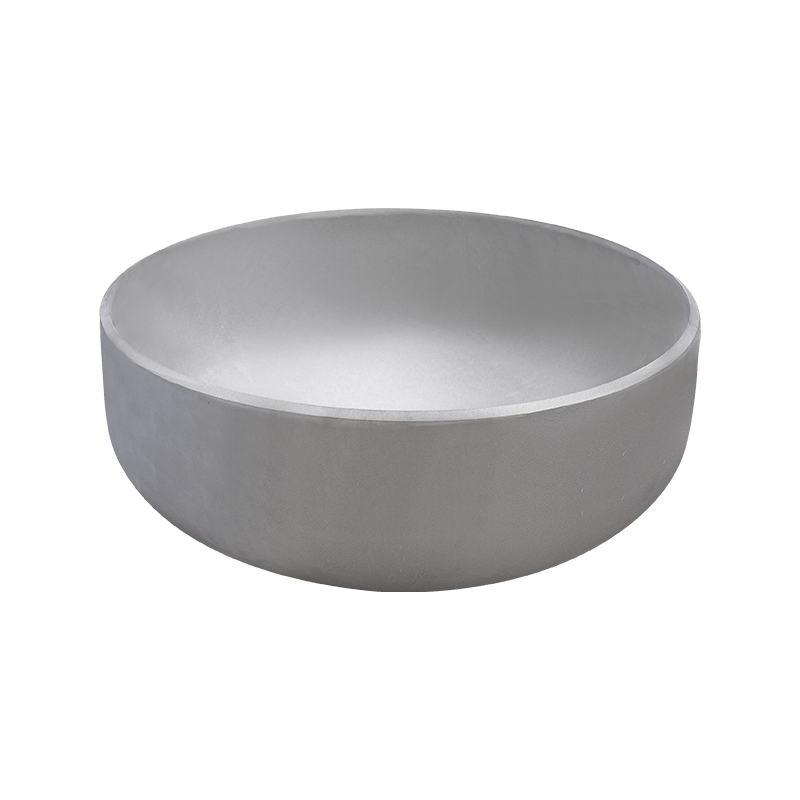
The 2:1 semi-ellipsoidal profile — where the depth of the dome equals half the inside radius of the pipe — is the most commonly specified butt weld cap geometry for standard industrial piping applications. This profile provides a favorable balance between pressure-containing efficiency and manufacturing practicality. The internal pressure stress in a 2:1 ellipsoidal head at the crown is approximately equal to that in the cylindrical pipe shell of the same diameter and thickness, meaning that the cap wall does not need to be thicker than the connected pipe to sustain the same internal pressure. ASME B16.9 — the governing standard for factory-made wrought butt welding fittings in North America — specifies the dimensional requirements for standard pipe caps across the nominal pipe size (NPS) range, and most commercially available carbon steel, stainless steel, and alloy steel caps in standard wall thicknesses conform to this standard.
Hemispherical Caps
Hemispherical butt weld caps — where the dome forms a complete half-sphere — offer the highest pressure efficiency of any closed-end geometry, with the crown stress being exactly half that of an equivalent cylindrical shell. This means hemispherical caps require the thinnest wall of any head type for a given design pressure, making them the preferred choice for very high-pressure applications — subsea pipelines, high-pressure gas vessels, and hydraulic test end closures — where material weight and cost are critical. The trade-off is greater manufacturing complexity: forming a true hemisphere requires more material deformation and more precise tooling than an ellipsoidal profile, which increases manufacturing cost and lead time compared to standard ellipsoidal caps.
Flat Caps
Flat butt weld caps — with a flat closed end rather than a domed profile — are the least pressure-efficient geometry but are used in low-pressure applications where simplicity of manufacture or internal access for inspection and cleaning is a priority. A flat closure requires significantly greater wall thickness than a domed head to sustain the same internal pressure, because the flat plate must resist bending stress across its full diameter rather than distributing hoop stress through a curved shell. Flat caps are common in atmospheric storage, low-pressure instrument connections, and maintenance closures where pressure is not a design driver.
Material Grades and Standards for Butt Weld Pipe Caps
Butt weld pipe caps are manufactured in a comprehensive range of material grades to match the connected piping system's pressure, temperature, and corrosion resistance requirements. The material specification of the cap must be compatible with the pipe material for welding — matching or closely similar chemical composition, carbon equivalent, and mechanical properties — to ensure that the butt weld joint can be made with appropriate filler metal selection and preheat requirements without introducing weld metallurgy problems.
| Material Grade | ASTM Specification | Temperature Range | Typical Application |
| Carbon Steel (A234 WPB) | ASTM A234 Gr. WPB | −29°C to +427°C | General process, oil & gas, water |
| Low-Temp Carbon Steel (WPC) | ASTM A420 Gr. WPL6 | −46°C to +343°C | Cryogenic, LNG, cold service |
| 304/304L Stainless Steel | ASTM A403 Gr. WP304/L | −196°C to +538°C | Chemical, food, pharmaceutical |
| 316/316L Stainless Steel | ASTM A403 Gr. WP316/L | −196°C to +538°C | Marine, chloride environments |
| Chrome-Moly (P11, P22) | ASTM A234 Gr. WP11/WP22 | Up to +593°C | High-temp steam, refinery |
| Duplex Stainless (2205) | ASTM A815 Gr. WPS31803 | −50°C to +316°C | Offshore, seawater, sour service |
| Nickel Alloy (Inconel, Hastelloy) | ASTM B366 | Up to +1,093°C | High-temp, highly corrosive service |
For carbon steel caps in standard service, ASTM A234 Grade WPB is the universal specification covering caps manufactured from seamless or welded and drawn carbon steel pipe or plate. The "WP" prefix in the grade designation denotes "wrought pipe fitting," confirming that the fitting has been formed by hot or cold mechanical working rather than casting. Cast fittings — while sometimes used for butt weld ends — have different quality considerations and are governed by separate ASTM standards. The choice between seamless and welded-and-drawn manufacture affects cap quality, particularly in larger sizes above NPS 12 where seamless manufacture becomes less practical and welded construction becomes the norm. Specifying seamless caps in critical service applications — high-pressure, high-temperature, or hydrogen service — is standard practice to eliminate the weld seam as a potential preferential corrosion or hydrogen embrittlement initiation site.
Dimensional Standards and Size Range for Butt Weld Caps
The dimensional requirements for butt weld pipe caps are governed by internationally recognized standards that define the outside diameter, wall thickness, end-to-end length, and bevel angle of the fitting across the full range of nominal pipe sizes. Compliance with these standards ensures interchangeability between fitting suppliers and compatibility with pipe dimensions from different manufacturers — a critical requirement for the integrity of welded piping systems.
ASME B16.9 is the primary dimensional standard for factory-made wrought butt welding fittings in North American and internationally supplied piping, covering caps from NPS ½ (DN 15) through NPS 48 (DN 1200) in standard, extra-strong (XS), and double extra-strong (XXS) wall thicknesses. The standard specifies the center-to-end or end-to-end dimensions for each fitting type, the permissible dimensional tolerances, and the marking requirements for traceability. MSS SP-75 covers high-yield-strength butt weld fittings used in pipeline service, while EN 10253 is the equivalent European standard governing butt weld fitting dimensions for piping systems installed under European regulatory frameworks.
For sizes above NPS 24, butt weld caps are increasingly produced as custom fabrications rather than standard factory-made fittings — formed from plate by pressing and spinning operations, then trimmed and beveled to the required dimensions. These fabricated large-bore caps must still meet the applicable dimensional and material standards but may have longer manufacturing lead times and higher unit costs than standard catalog items in smaller sizes. Procurement of large-bore caps for critical service applications should include dimensional inspection at the manufacturer's facility and material certification review before shipment.
Wall Thickness Schedule Selection and Pressure Rating Implications
Butt weld pipe caps are available in wall thicknesses corresponding to standard pipe schedule designations — Schedule 40, Schedule 80, Schedule 160, XS, and XXS being the most common for carbon and stainless steel applications. The wall thickness of the cap must be equal to or greater than the wall thickness of the connected pipe to ensure that the cap does not become the weakest pressure-containing element in the piping system. In practice, pipe caps are typically specified to match the pipe schedule of the connected pipe, and the ASME B31.3 or applicable piping code provides the design rules for calculating the required wall thickness based on design pressure, design temperature, and material allowable stress.
The pressure rating of a butt weld cap is not expressed as a fixed value on the fitting itself — unlike flanged fittings which carry a pressure class rating — but is instead determined by the wall thickness, material grade, and design temperature of the specific cap in the context of the applicable design code. This approach means that a Schedule 80 carbon steel cap rated for one pressure at ambient temperature will have a reduced allowable working pressure at elevated temperature, as the material's allowable stress decreases with increasing temperature. Engineers specifying butt weld caps for elevated temperature service must verify that the cap wall thickness is sufficient at the maximum design temperature, not just at ambient conditions.
Key Industrial Applications of Butt Weld Pipe Caps
Butt weld pipe caps appear in virtually every sector of industrial piping construction, serving a range of specific functional roles beyond simple line termination. Understanding these applications helps piping engineers and procurement teams specify the correct cap type and material for each use case.
- Permanent dead-end termination of branch lines: In process plant and refinery piping, branch connections that are installed for future expansion but not immediately connected to process equipment are capped with butt weld caps welded to the branch pipe end. The permanent weld provides a leak-free closure that can sustain the full system test pressure and process operating pressure indefinitely, with no risk of the loosening or leakage that can occur with threaded or bolted blind closures over time.
- Hydrostatic pressure testing: Before a piping system is commissioned, it is pressure-tested to verify the integrity of all welds and fittings. Butt weld caps are welded onto open pipe ends during the test phase to close the system for pressurization. After successful testing, the caps may be cut off and removed if the pipe ends will be connected to equipment or other piping sections, making the cap selection for test purposes focused on wall thickness adequacy for the test pressure rather than long-term service considerations.
- Pipeline pigging stations and pig receivers: In pipeline systems designed for internal inspection and cleaning using pipeline inspection gauges (pigs), butt weld caps are used as the closure element at the end of pig launchers and receivers. The cap is either permanently welded for systems using permanent pig receivers with a separate access door, or is replaced with a quick-opening closure in high-frequency pigging operations. The cap must be rated for the full pipeline operating pressure and temperature.
- Subsea and offshore pipeline terminations: Subsea pipeline termination units (PLETs) and pipeline end manifolds (PLEMs) use heavy-wall butt weld caps on the pipeline ends during construction and installation phases, providing a pressure-tight closure that can withstand hydrostatic external pressure at installation depth as well as the internal test pressure applied before the pipeline is commissioned. Subsea caps are typically manufactured from high-quality seamless carbon steel or duplex stainless steel with full nondestructive examination (NDE) — including radiographic testing of the weld seam in welded caps and ultrasonic testing of the cap body — to meet the stringent quality requirements of subsea pipeline codes.
- Chemical and pharmaceutical process piping: In stainless steel process piping for pharmaceutical manufacturing, food processing, and specialty chemical production, butt weld caps close sampling ports, instrument connections, and branch lines under hygienic or ultra-clean piping standards. Stainless steel caps in these applications are specified with internal surface finish requirements — typically Ra ≤ 0.8 μm electropolished for pharmaceutical applications — to prevent microbial or product residue accumulation in the closed end of the cap.
Welding, Inspection, and Quality Requirements for Butt Weld Cap Joints
The integrity of a butt weld pipe cap installation depends on the quality of the welded joint between the cap and the pipe, which must be executed by qualified welders following an approved welding procedure specification (WPS) in accordance with the applicable piping code — ASME B31.3 for process piping, ASME B31.4 or B31.8 for pipelines, EN 13480 for European process piping, or equivalent national codes. The butt weld joint between the cap and pipe is a full-penetration groove weld requiring complete fusion through the entire pipe wall thickness, verified by nondestructive examination appropriate to the fluid service and pipe class.
For normal fluid service carbon steel piping in ASME B31.3, the minimum NDE requirement for butt welds is random radiographic or ultrasonic testing at 5% of joints in each weld category, with visual examination of all welds. For Category D fluid service (low-pressure, non-flammable, non-toxic fluids), visual examination alone may be sufficient. For high-pressure service, cyclic service, or fluids classified as Category M (highly toxic), 100% radiographic or ultrasonic examination of all butt weld joints is required, which includes the cap-to-pipe weld. Weld quality requirements expressed in acceptance criteria per ASME Section V and Section IX must be met before the joint is accepted and the system is pressure tested.
Preheat requirements for welding carbon steel and chrome-moly alloy caps follow the material-specific requirements of ASME B31.3 Table 330.1.1 and AWS D1.1 or equivalent, based on carbon equivalent, wall thickness, and ambient temperature. Stainless steel caps generally do not require preheat but may require interpass temperature control during welding to prevent sensitization of the heat-affected zone — a particular concern for standard-carbon grades such as 304 and 316 in service involving high temperatures or corrosive media. Low-carbon "L" grades (304L, 316L) are preferred in welded stainless steel piping to minimize sensitization risk without requiring post-weld heat treatment.
Procurement Checklist for Butt Weld Pipe Caps in Critical Service
For buyers and project engineers sourcing butt weld pipe caps for critical industrial piping applications, a structured procurement checklist prevents specification errors and quality shortfalls that can result in costly field replacements or integrity failures.
- Confirm nominal pipe size and schedule: Verify that the cap NPS and schedule match the connected pipe exactly — not the pipe's outside diameter alone, as pipes of the same NPS but different schedules have the same OD but different wall thicknesses and therefore different bevel preparations.
- Specify material grade and ASTM specification: Include both the ASTM material specification number and the specific grade designation — for example "ASTM A234 Grade WPB" rather than simply "carbon steel" — to avoid substitution with lower-grade or non-conforming material.
- Require material test reports (MTRs): For pressure service applications, require certified material test reports (CMTRs) traceable to the cap heat number, confirming chemical composition and mechanical properties in compliance with the specified ASTM standard.
- Specify seamless or welded construction: For high-pressure, hydrogen, or sour service applications, specify seamless construction explicitly — do not allow welded-and-drawn substitution without engineering review and approval.
- Confirm applicable dimensional standard: Specify compliance with ASME B16.9 (North American projects), EN 10253 (European projects), or the project-specific piping material specification to ensure dimensional compatibility with the connected piping components.
- Verify marking and traceability requirements: ASME B16.9 requires that caps be marked with the manufacturer's identification, material grade, size, and schedule. For critical service, additional heat number marking and color coding per project piping material class specifications may be required to maintain material traceability through the construction phase.
Latest News
News And Blogs
Stay Informed About Our Recent Events